In this guide
- Name your present stage precisely
- Distinguish nursing occupations before comparing programs
- Read student routes as eligibility conditions
- Keep graduation, examination, license, and start date apart
- Read residency descriptions at the right level
- Evaluate the learning structure with concrete questions
- Treat experienced practice as evidence, not a reset
- Make a decision checkpoint before the next commitment
- Sources and scope
Student work, graduation, licensure, residency, and experienced practice are different milestones. Build a plan that keeps their requirements visible.
Name your present stage precisely
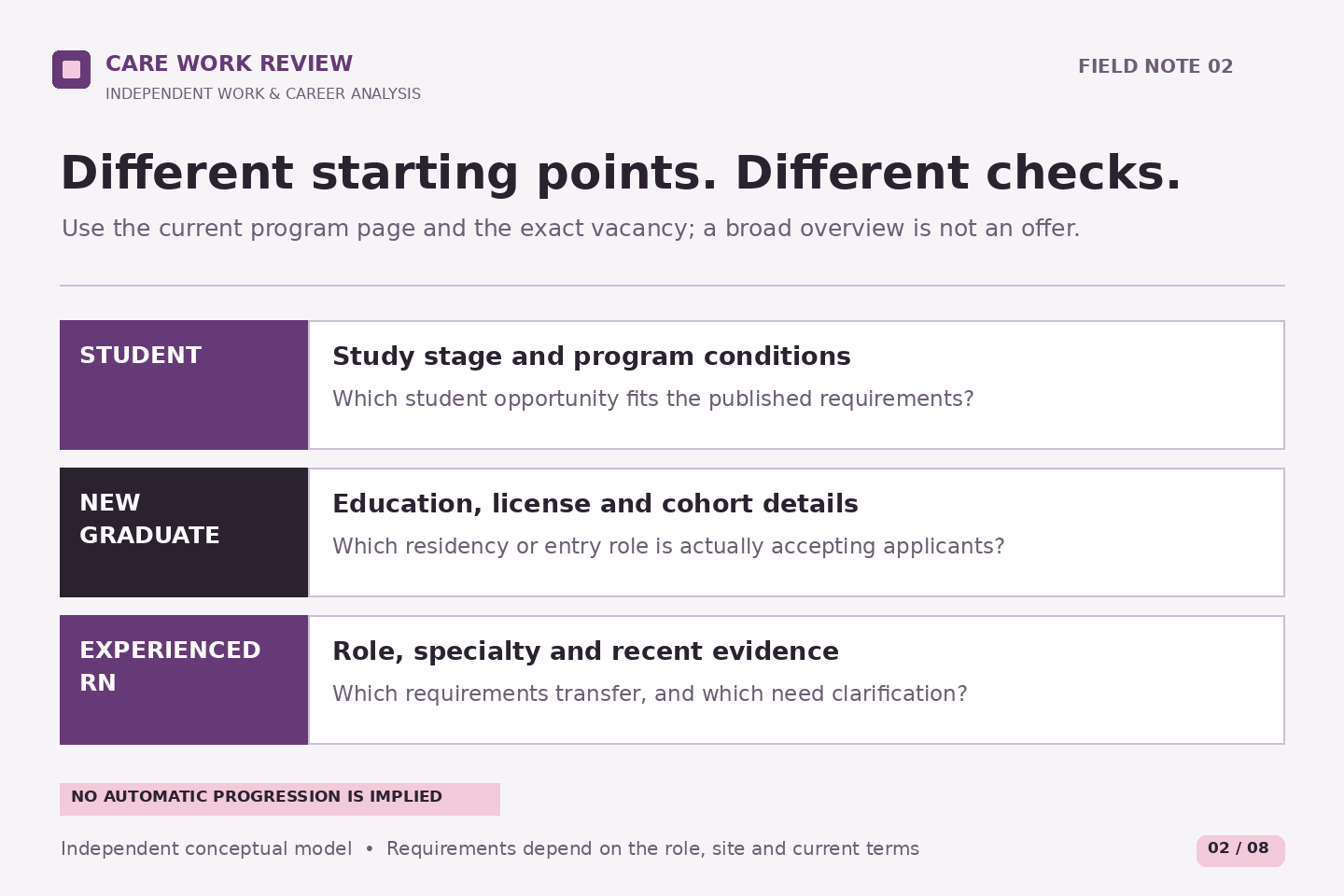
A nursing career search becomes more useful when its starting point is explicit. Are you exploring education, enrolled in a nursing program, approaching graduation, newly licensed, or practicing as an experienced registered nurse? Each stage produces different questions and different evidence. Being near a milestone is not the same as having completed it, and a future completion date should not be written as a current qualification.
MedStar Health's Nursing Student Career Paths page presents student nursing assistant, student nurse extern, nurse residency, and registered nurse routes. Read these as published categories for investigation. They do not mean that a student moves through all four automatically, that every location offers each route, or that a position is available when you read this article. This is independent career-planning information, not clinical instruction or a promise of employment.
Distinguish nursing occupations before comparing programs
BLS identifies several educational routes into registered nursing, including a nursing bachelor's degree, an associate degree, and a diploma from an approved program; RNs must be licensed. BLS separately describes practical or vocational nursing and nursing-assistant occupations. Practical nurses complete an approved program and require licensure. Nursing assistants typically complete a state-approved program and competency examination, with requirements varying by state.
The practical implication is that words such as “nursing,” “assistant,” and “student” are not interchangeable evidence. Write the exact credential a course awards, the occupation it prepares you to enter, and the body that decides any required authorization. Ask the program and relevant licensing authority about your own circumstances before committing money. An employer's willingness to consider an application is a separate question from a regulator's requirements or a school's admission decision.
Read student routes as eligibility conditions
The current MedStar student-path overview lists active enrollment in an accredited RN program and completion of Fundamentals or Foundations of Nursing for its student assistant and extern routes. It also lists basic life support certification; the extern overview adds being within one year of graduation. Those are statements from the public overview checked October 1, 2026, not an assessment of your application or permission to undertake a task.
Translate each condition into a question with an owner. Your school can confirm your enrollment or course completion. The employer can clarify the acceptable evidence and the conditions for a particular vacancy. A licensing or certifying body can answer questions within its authority. If the posting's language is unclear, preserve the wording and ask rather than selecting a favorable interpretation. Here “BLS certification” means basic life support, not the Bureau of Labor Statistics cited elsewhere in this guide.
Keep graduation, examination, license, and start date apart
Our original milestone ledger uses four rows: education completion, examination requirement, professional authorization, and employment start. For each row, record the expected date, the evidence that will establish completion, who issues that evidence, and the next dependency. Add a fifth row for any role-specific certification. The ledger is a private planning aid; do not publish credential numbers, identity documents, examination records, or screenshots from private accounts.
A hypothetical graduate might expect to finish school in May and hope to begin work in July. Those dates do not prove that examination, licensing, verification, and hiring steps will align. Instead of announcing an unconditional July start, the candidate can identify what remains pending and ask the recruiter how the specific opportunity handles it. Keep forecast dates visibly separate from confirmed ones so that a changed milestone does not quietly make the rest of the plan inaccurate.
Read residency descriptions at the right level
MedStar's current Nursing Student Career Paths overview describes a twelve-month nurse residency and lists ADN or BSN, successful NCLEX completion, and basic life support certification. Separately, MedStar Washington Hospital Center's residency page describes classroom learning, simulation, clinical preceptorship, and continuing development. Those sources establish published program descriptions, not an individual offer, cohort place, specialty assignment, or the complete conditions of employment.
Public pages may differ in specificity or update timing. The broader MedStar nursing page refers to baccalaureate-prepared new-to-practice nurses, while the student-path page lists ADN or BSN. Do not silently combine the two into a new rule. Ask about the exact site, requisition, and cohort you are considering. Current written clarification is more useful than assuming a general website sentence overrides a position's requirements.
Evaluate the learning structure with concrete questions
A promise of support is easier to evaluate when you ask how learning is organized. Who is the day-to-day learning contact? How is progress discussed? Which activities are scheduled separately from normal work? How are questions raised when the assigned contact is unavailable? These questions seek an explanation of the program rather than a guarantee that the transition will be easy. They also avoid asking an employee to disclose patient cases or confidential staffing information.
Build a two-column comparison: published structure and clarification needed. Under published structure, record only what the official page actually says. Under clarification, write the practical questions that matter to your decision, such as attendance requirements, site changes, or how orientation relates to a recurring schedule. Leave an answer blank when it is unknown. Marketing language, a general program length, and a welcoming conversation are not substitutes for the specific terms you need to plan your life.
Treat experienced practice as evidence, not a reset
An experienced RN considering a different setting needs a different plan from a student entering the profession. MedStar's broad nursing page describes work across hospital, ambulatory, home-care, research, and other environments. That variety invites exploration; it does not establish that experience in one setting satisfies another position's specialty requirements. A job title shared across departments may conceal very different expectations.
Prepare a transfer-of-experience note with three sections: strengths you can substantiate, areas where your experience is adjacent, and areas where you need structured learning. For example, experience communicating across shifts may transfer, while familiarity with a particular service's workflows may not. Describe this honestly without presenting patient details or confidential internal measures. Ask how the employer evaluates the relevant experience and what preparation would be necessary for the specific opportunity.
Make a decision checkpoint before the next commitment
Before applying, accepting a program place, or paying for education, review the milestone ledger against current official information. Mark each entry confirmed, pending, or unclear. The best next action is usually the one that resolves a dependency: a question about program approval, a missing qualification, a current posting's experience threshold, or the relationship between orientation and scheduled hours. More applications do not resolve a misunderstood requirement.
Use Turn career learning into a small, testable plan for a bounded development plan and Read the whole pattern behind a shift label for schedule questions. If an opportunity reaches the offer stage, use Compare the offer you can verify to evaluate its actual terms. Neither an educational qualification nor a supportive conversation guarantees selection, licensure, residency admission, or later advancement. A good nursing career plan keeps those decisions with the organizations authorized to make them and keeps your own choices grounded in verifiable evidence.
Related reading: Build an early-career plan that survives a changing vacancy list, Turn career learning into a small, testable plan, Read a vacancy as a set of separate commitments.