In this guide
- First preserve the identity of the vacancy
- Use six rows and an evidence label
- Work: translate duties into evidence you can discuss
- Entry: keep requirements and preferences distinct
- Time and place: test the conditions together
- Reward: avoid adding unlike numbers
- Try the rubric on a deliberately incomplete pair
- Finish with a decision and its conditions
- Sources and scope
Use a practical vacancy rubric to separate entry requirements, work conditions, compensation language and questions that still need an answer.
First preserve the identity of the vacancy
Two postings with similar titles can describe different work. Before comparing them, record the requisition number, full title, department, named employer or facility, location and the date you read the page. Save a private copy or a small factual summary for your own reference. If a listing changes or disappears, that record helps you describe what you originally considered without presenting an old copy as current.
Begin through the official MedStar careers site, then read the complete vacancy rather than a search-result snippet. Search filters are useful for discovery; they are not the full terms of employment. A category label such as nursing, allied health or administrative work does not replace the duties and qualifications inside the posting. Your comparison should make those differences visible before you start tailoring an application.
Use six rows and an evidence label
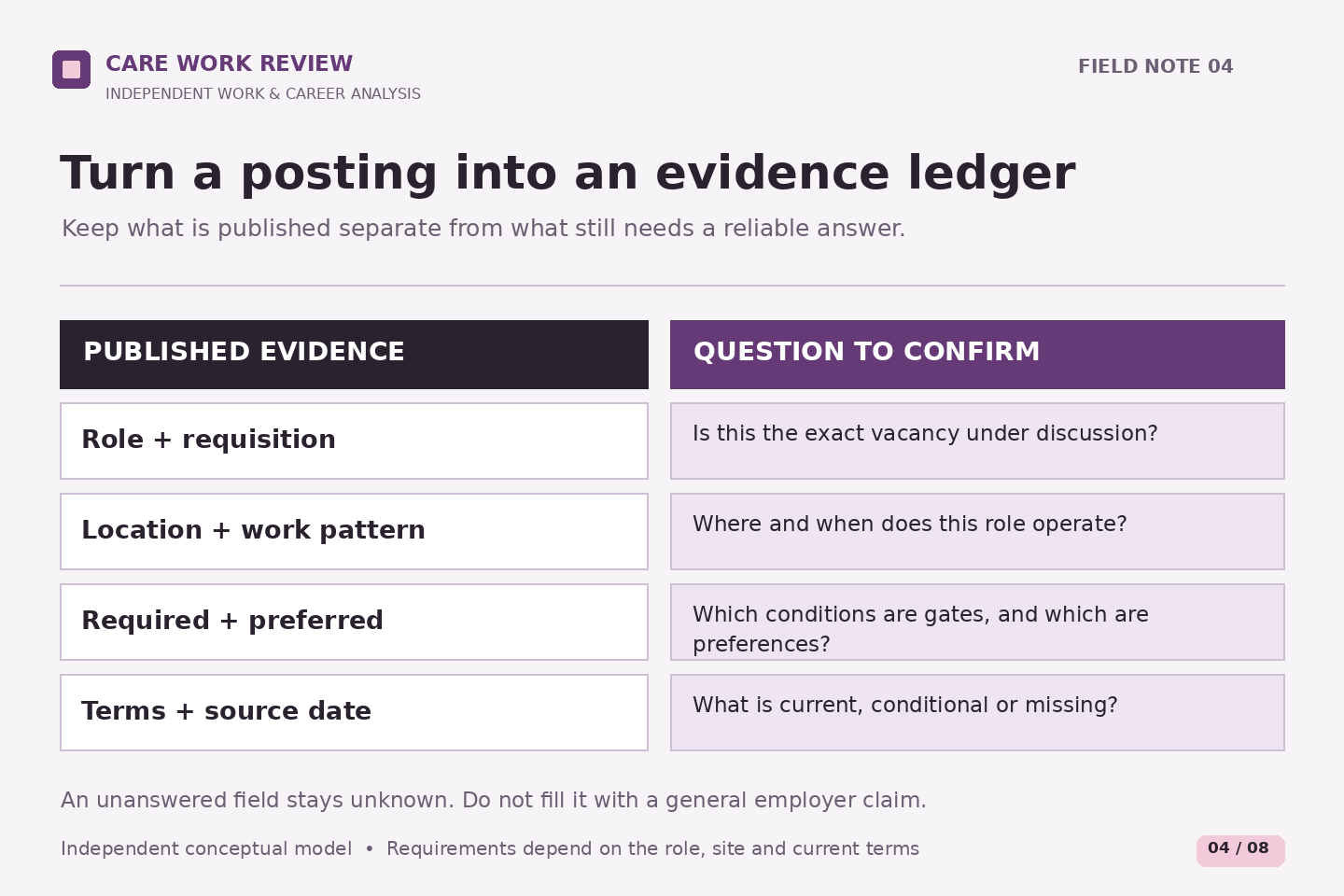
Our original vacancy rubric has six rows: work, entry, time, place, reward and uncertainty. Work captures the duties and outputs. Entry captures required education, experience and credentials. Time covers status, hours and coverage. Place covers the actual site and movement expectations. Reward separates pay language from benefits and any conditional extras. Uncertainty contains the questions that remain after careful reading.
Next to each entry, use one of three labels: stated, interpreted or unanswered. Stated means you can point to a sentence in the vacancy. Interpreted means you have drawn a plausible conclusion that still needs checking. Unanswered means the listing does not resolve it. Never quietly promote an interpretation into a stated fact.
For example, “full time” may be stated while “the same weekdays every week” remains unanswered. “Experience preferred” is stated; “I will be selected without that experience” is not. The labels keep the rubric honest without turning it into an automatic eligibility score.
Work: translate duties into evidence you can discuss
Read each duty as a verb and an object. Scheduling appointments, maintaining equipment documentation and preparing reports describe different outputs even when all three involve software. Group related duties into two or three work themes. A candidate can then identify evidence for the actual work rather than repeating a list of generic strengths.
Consider the official Medical Office Assistant II Fairfax example, requisition 165546, reviewed on October 1, 2026. It identifies a specific department and includes clerical support, scheduling and record-related responsibilities. Its value here is the structure: several kinds of work sit beneath one title. The example is not a recommendation to apply or evidence that the opening is still available.
For each theme, write a question about scale or context that the posting leaves open. “Which responsibilities take most of the week?” is more informative than asking whether the job is busy. Avoid assuming that every listed duty occurs daily or occupies equal time.
Entry: keep requirements and preferences distinct
Copy the logic of the qualification section accurately. Required, preferred, equivalent and within a stated period are different conditions. A list joined by “and” can mean something different from alternatives joined by “or.” If the meaning is unclear, preserve the exact wording in your private notes and seek clarification through the official hiring route.
Separate four questions: Do I have the stated qualification? Can I document it? Is its current status accurate? Does the employer need to assess equivalence or timing? A completed course, an in-progress credential and a current professional authorization are different kinds of evidence. Do not select a positive answer on an application because you expect a future step to work out.
For illustration, the Georgetown laboratory posting numbered 166436 places education, experience and certification in separate fields. That is a reason to read each field, not to assume one automatically substitutes for another. This publication cannot determine whether a particular qualification satisfies the employer or a jurisdiction's requirements.
Time and place: test the conditions together
A schedule only becomes practical when it is attached to a place. The Fairfax posting reviewed for this guide specified an onsite location and a Monday-to-Friday schedule. A different listing may give only a broad shift label or several available arrangements. Record only the arrangement applicable to the vacancy you are discussing, then ask which unresolved details are fixed.
Check whether weekly hours, shift start and end, rotation, weekend work, call or travel are described. The absence of a condition from a summary is not evidence that it never applies. Conversely, do not assume every healthcare role has overnight or holiday work. The right answer comes from the exact role.
Build a sample week using confirmed information. Put a question mark where you would otherwise have to invent a start time or location. This exposes practical dependencies before you become attached to a position because of its title alone.
Reward: avoid adding unlike numbers
Compensation sections may describe an hourly hiring range, an annual amount, shift-related pay or a conditional incentive. Put each in its own line with its stated basis. An advertised range is not an individual offer, and a conditional payment is not the same as recurring base pay. Do not invent a midpoint offer or assume the maximum applies to you.
For a useful comparison, first align the units. If you privately estimate earnings, label the calculation as your scenario and write down the assumed paid hours. Keep uncertain overtime, differentials and incentives out of the baseline. Their conditions may matter more than the headline amount.
Benefits deserve a separate question list. An official public summary can identify categories to investigate, but it cannot tell you the cost or eligibility applicable to a particular employment arrangement. Request the relevant current materials if the hiring process advances, and compare the same coverage year and employee category.
Try the rubric on a deliberately incomplete pair
Here is a hypothetical comparison, not a pair of actual MedStar offers. Vacancy A states forty weekly hours, one site and a defined schedule. Vacancy B has a higher advertised hourly range but leaves weekly hours and location coverage unclear. Both describe work the applicant can support with relevant examples. A simple pay ranking would put B first before the necessary facts are known.
The rubric produces a better result. A has fewer unresolved practical questions; B needs clarification about paid hours and location. The applicant can continue with either or both, but should not claim B is financially or logistically better yet. Nor should they treat the missing information as proof that B is unsuitable.
Create a short question sequence rather than a long interrogation. Ask first about conditions that could stop the process, then about distinctions that would help choose between otherwise workable options. That respects everyone's time and makes the next conversation focused.
Finish with a decision and its conditions
Your reading should end in one of three useful states: ready to prepare an accurate application, interested but needing a specific clarification, or not pursuing because a confirmed condition does not fit. Record the reason in a sentence. You do not need to turn every interesting listing into an application.
If you proceed, use the work and entry rows to prepare your evidence, and carry the unanswered items into an appropriate recruiter or interview conversation. Recheck the live listing before submitting. This rubric organizes judgment; it does not predict selection, establish eligibility or replace written employment terms.
Related reading: Build an application around evidence you can explain, Compare the offer you can verify, Ask benefits questions in the order that matters.