In this guide
Day, night, full time and PRN leave important questions open. Turn a shift description into a realistic calendar before comparing roles.
A label is the beginning of a schedule
A shift label compresses information. “Day” may help you filter vacancies, but it does not necessarily answer which days, how many hours, how frequently weekends occur or whether the arrangement rotates. “Full time” describes an employment category without, by itself, giving you the whole calendar. Read the detailed schedule and status fields together.
The Bureau of Labor Statistics describes hospital nursing as work that commonly uses shifts for continuous coverage, while nursing in settings without round-the-clock care is more likely to follow business hours. This is national occupational context, not a promise about MedStar or any one job. It is useful because it suggests questions to ask, not because it can fill gaps in a posting.
Build a schedule description in five parts
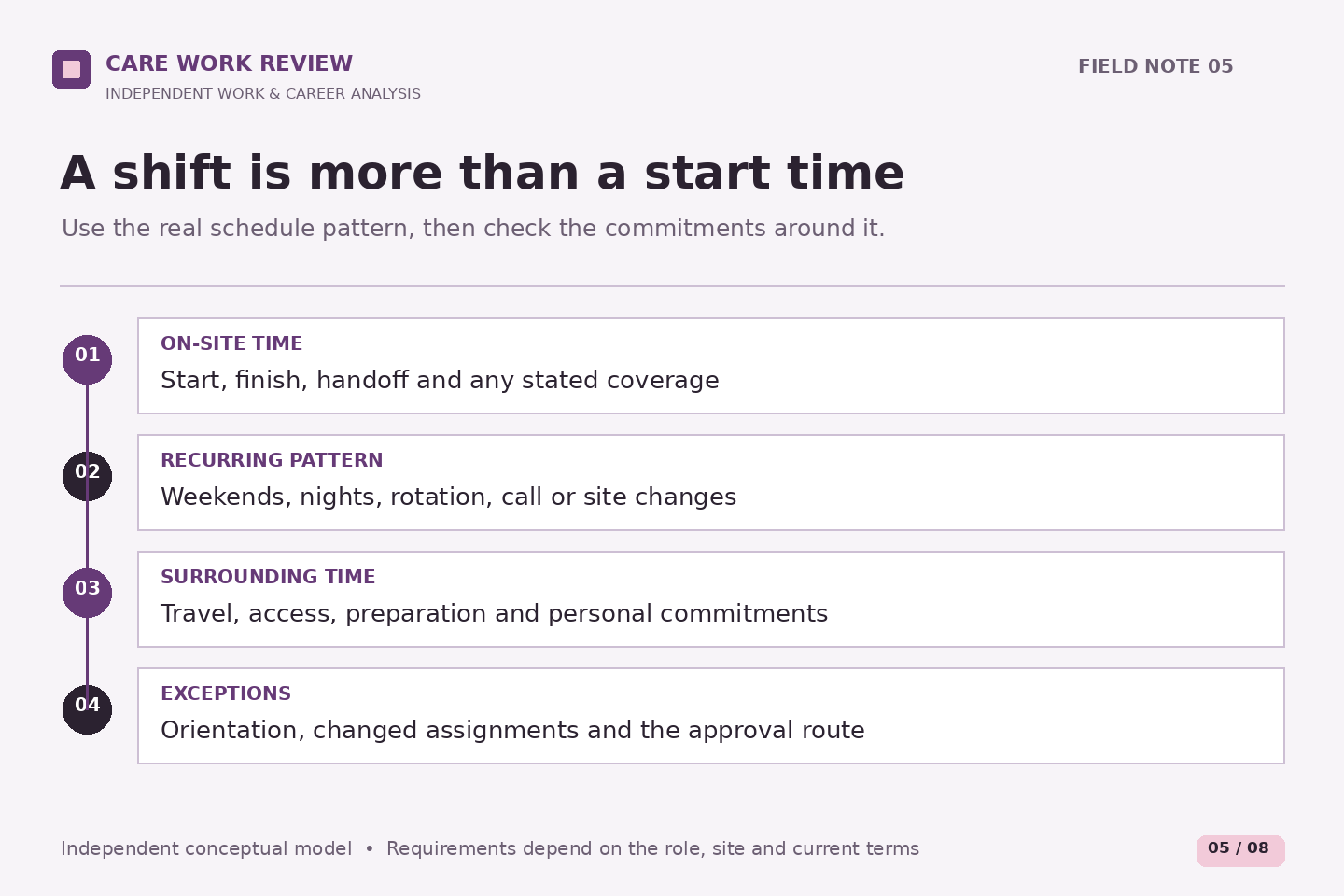
Write the pattern in five parts: hours per shift, shifts or hours per period, placement within the week, rotation or coverage obligations, and the process for changes. Leave unknown parts blank. A clear description might include precise hours but leave holiday rotation unanswered. That gap deserves a question; it does not justify borrowing a policy from another unit.
Real public examples show why this detail matters. MedStar's Franklin Square float-pool listing, requisition 168604, distinguished full-time and PRN commitments, including different scheduling requirements. The Georgetown laboratory listing, requisition 166436, specified overnight hours and rotating weekends. These were examples reviewed on October 1, 2026, not current availability guarantees or rules for other jobs.
Do not merge the most appealing elements from several arrangements in one posting. If a listing offers multiple options, confirm which option is under discussion and which conditions belong to it.
Draw a repeating cycle, not just a good week
A one-week sketch can hide a rotation. Ask what period best represents the pattern: a week, several weeks, or another defined cycle. On a private calendar, place confirmed work blocks, commute time and personal commitments. Use a different mark for assumptions. You are testing whether the arrangement is workable, not constructing an official schedule.
For a hypothetical example, imagine a role with three scheduled workdays per week and a recurring weekend obligation. The total number of workdays may look attractive, while their placement conflicts with a fixed outside commitment. Counting days alone misses the issue. The applicant needs the rotation clarified before deciding, rather than assuming the days off will always fall conveniently.
Treat transition time as real. The end of a scheduled shift and arrival home are different moments. Likewise, arriving at a campus, reaching the work area and being ready to begin are separate steps. Use your own realistic travel estimate and verify the relevant work location.
Separate availability, assignment and flexibility
Availability describes when you can work. An assignment describes when you are expected to work. Flexibility describes what can change and through whose approval. These are not interchangeable. A candidate saying “I am available on weekdays” has not established that an employer will provide a weekday-only schedule. A preference recorded in a conversation is not necessarily an agreed condition.
Ask practical questions: How far ahead is a schedule typically communicated? Which elements are fixed? How are requests considered? What coverage requirements apply to this employment status? If the answer depends on a unit, direct the question to someone responsible for that unit rather than expecting a broad careers page to settle it.
PRN or as-needed language deserves the same care. Do not translate it automatically into unlimited choice, guaranteed hours or no minimum commitment. Use the actual posting and current terms to understand the arrangement.
Compare the pattern with the rest of life
A realistic comparison includes dependable personal obligations without requiring you to disclose their private details. You can state a work-availability constraint directly. For your own planning, consider transportation, recurring appointments, study, household coordination and the time you need between commitments. This is a logistics exercise, not advice about a person's medical fitness for shift work.
Try a disruption test. What would you do if the usual transport option were unavailable, a scheduled day changed through the agreed process, or an additional site were assigned within the role's terms? A backup does not have to solve every imaginable event. It should identify the assumptions most likely to break your plan.
If a required pattern does not fit, acknowledge that before relying on an informal hope that it will change after starting. Where an adjustment is needed, ask through the appropriate official process. This article cannot determine what arrangement will be available.
Keep a written distinction between known and pending
After a hiring conversation, summarize the relevant conditions for yourself: the arrangement discussed, the person or official document that supplied it, the date and the remaining question. If a material point is unclear, ask for clarification before making a decision. A useful question is narrow: “Does the weekend requirement you described apply to this specific position and status?”
Revisit the pattern if the role, location or employment category changes. Do not carry assumptions from an earlier conversation into a different vacancy. A well-read schedule is a set of connected conditions, not a reassuring word in a search filter. The aim is to enter the process with a calendar you can explain and questions that the right person can actually answer.
Related reading: Test the whole week before a schedule changes, Choose a setting by the workday it creates, Compare the offer you can verify.