In this guide
- Start with the contribution you want to make
- Keep the occupation, setting, and vacancy separate
- Direct care includes distinct professions
- Diagnostic and therapeutic work needs a closer lens
- Administrative work has its own range of responsibility
- Technology work can support care without being a clinical role
- Try the four-filter decision sheet
- Work through a hypothetical comparison
- Turn the map into a small, testable next step
- Sources and scope
A practical map of clinical, administrative, and technical work, with a decision method for comparing MedStar Health career directions.
Start with the contribution you want to make
“I want to work in healthcare” is a direction, not yet a job search. You might mean sustained contact with patients, precise technical work, keeping a service organized, or improving the systems that make other people's work possible. Those preferences point toward different occupations. Beginning with a familiar hospital job title can hide options that better fit your existing abilities and the education you can realistically undertake.
MedStar Health's public professional directory separates routes for nurses, advanced practice providers, patient support professionals, administrators, and researchers. That is useful evidence that a health system contains multiple kinds of work. It is not an assurance that every category currently has a suitable vacancy. This independent guide organizes the choices using public information; it does not rank MedStar as an employer or promise an interview, appointment, promotion, or job.
Keep the occupation, setting, and vacancy separate
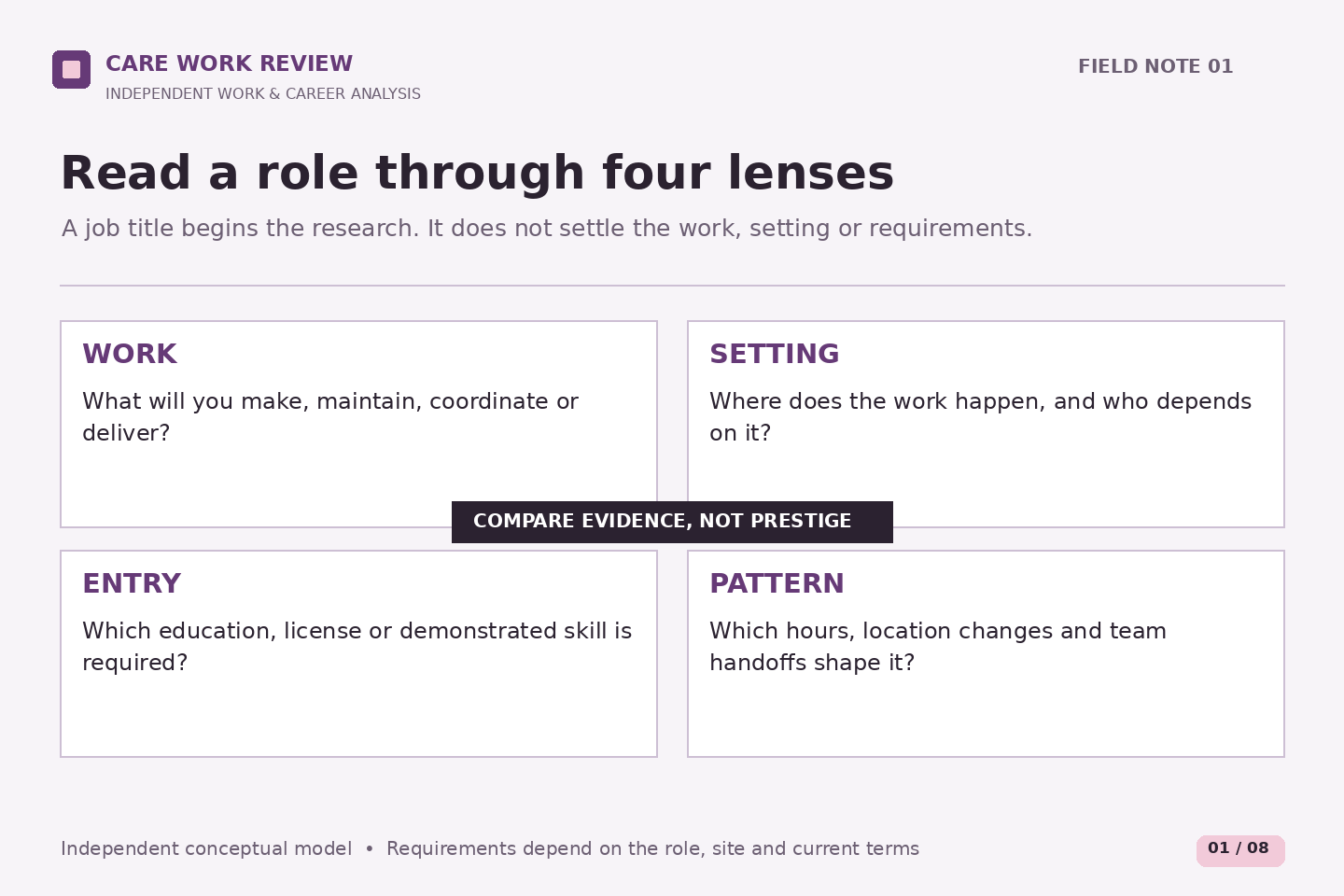
An occupation describes a recognizable kind of work. A setting describes where it happens. A vacancy describes one employer's present requirements for a particular position. A registered nurse is an occupation; an outpatient service is a setting; a posting with a requisition number is a vacancy. You need all three layers before making a serious comparison. A promising occupation can still lead to an unsuitable commute, schedule, specialty, or experience requirement.
Use the Bureau of Labor Statistics Occupational Outlook Handbook to understand occupations, and the current MedStar posting to understand a position. BLS education descriptions are typical entry routes across the occupation, not individualized licensing advice or an employer's offer. Similarly, a national wage figure cannot tell you what a MedStar hiring team will offer. Record the publication period and geography if you use labor-market data; do not mix a national median with a local advertised range.
Direct care includes distinct professions
BLS describes registered nurses as providing and coordinating patient care. Medical assistants combine administrative and clinical tasks, while nursing assistants help with basic care and daily activities. These occupations may work near one another, but their education, authorization, supervision, and responsibilities differ. Patient contact is therefore a poor substitute for reading the actual role requirements. A role with frequent contact does not necessarily offer the professional scope that you want to develop.
To compare these directions, write one sentence about the work you hope to become qualified to do, then underline the qualification you would need to verify. Avoid treating an assistant position as an automatic short route to nursing. It may provide valuable experience while remaining a separate occupation. If nursing is your intended destination, use Separate the milestones in a nursing career plan to separate education, licensure, student work, and a new-to-practice position.
Diagnostic and therapeutic work needs a closer lens
Laboratory, imaging, respiratory, and rehabilitation work are useful starting categories for further research. BLS distinguishes clinical laboratory technologists and technicians, whose work concerns medical testing, from radiologic and MRI technologists, whose work concerns diagnostic imaging. The tools, education routes, and forms of patient interaction are not interchangeable. “Technical healthcare” is too broad a label to support a training decision.
Make a comparison around the work object: specimens and test processes; images and imaging encounters; rehabilitation activities; or respiratory care. Then ask what preparation the exact occupation requires and what the current posting adds. You are exploring an occupation, not authorizing yourself to perform any procedure. The Compare allied health paths without flattening the differences guide shows how to compare adjacent titles without assuming that shared terminology means shared eligibility.
Administrative work has its own range of responsibility
A healthcare organization also needs people who organize work, maintain records, support services, and manage operations. BLS treats administrative assistants, medical records specialists, and medical and health services managers as distinct occupations. A records role is not simply an office assistant with a different title, and a manager's accountabilities do not follow automatically from a general interest in hospital administration.
Ask what the person is responsible for getting right: a meeting and its follow-through, a reliable record, a service process, or a budget and team. This question makes prior experience easier to evaluate. Coordinating a complex public event may demonstrate organization; it does not prove medical coding knowledge. Supervising a retail team may demonstrate management experience; it does not establish the healthcare experience requested by a specific posting. Explore those differences in Find the responsibility inside an administrative job.
Technology work can support care without being a clinical role
Computer support, information analysis, clinical informatics, and equipment maintenance should not be collapsed into one “IT job.” BLS describes computer support specialists separately from medical equipment repairers and health information technologists. Some positions may be accessible through technical experience; others may require a specific qualification or prior clinical practice. The job's actual responsibilities matter more than an attractive department label.
For a technology search, identify the object of the work and the boundary of authority. Is the role helping a person use an application, maintaining a device, interpreting a data problem, or redesigning a workflow? Ask what can be changed independently and what requires review. The Read healthcare technology work by its operating boundary guide offers a portfolio exercise that demonstrates judgment without using patient records, workplace credentials, or unauthorized system access.
Try the four-filter decision sheet
Use our original four-filter sheet to select directions for research. This is an editorial planning tool, not a validated aptitude test. First, label the work you want more of: person-facing, diagnostic or therapeutic, organizing, or technical. Second, mark the preparation you can undertake: use existing qualifications, complete a defined short program, or pursue a longer professional route. Third, list practical limits such as travel, working hours, and study time. Fourth, name one piece of evidence that would make you reconsider the direction.
Apply a gate before a preference. A gate is a requirement that has to be resolved, such as an active professional license named in the posting. A preference is something you can trade off, such as the balance between meetings and independent work. Do not average away a missing gate with enthusiasm or attractive benefits. Use “unknown” when evidence is missing; uncertainty is a research task, not a failing score.
Work through a hypothetical comparison
Imagine a career changer with two years of office coordination experience, comfort with spreadsheets, and an interest in contributing to healthcare. They compare an administrative assistant direction, a medical records direction, and a registered nursing direction. The first may offer relevant transferable evidence; the second requires closer checking of specialist preparation; the third requires investigation of a professional education and licensing route. This example describes a method, not a finding about any real applicant's eligibility.
The useful result is not “choose administration.” It is a three-part plan: inspect current administrative postings against existing evidence; investigate the specific records qualifications before buying a course; and separately assess the feasibility of nursing education. The person can explore a longer-term goal without confusing it with an immediately suitable application. A different applicant, or a different posting, could reasonably produce a different sequence.
Turn the map into a small, testable next step
Choose two occupational directions and one setting to investigate first. Save the official occupation profile, find a current employer posting, and write down the largest unresolved requirement. Stop collecting titles once you can state a useful question. “Does this position accept my qualification?” or “How does this department divide patient contact and documentation?” is more actionable than “What jobs are good in healthcare?”
Then use Read a vacancy as a set of separate commitments to examine the vacancy and Choose a setting by the workday it creates to examine the environment. Keep application status, training admission, licensing eligibility, and hiring decisions separate throughout. This map does not establish any of them. Its purpose is to help you spend the next hour on the right evidence instead of spending weeks pursuing a title whose day-to-day work or entry requirements you have not yet understood.
Explore a work question and build a source-based reading brief.
Related reading: Separate the milestones in a nursing career plan, Compare allied health paths without flattening the differences, Find the responsibility inside an administrative job.