In this guide
Choose a work-relevant learning goal, check the route and support, and define what will show progress before committing time or money.
Choose the work you want to do better
A learning plan becomes easier to evaluate when it begins with an activity. “Develop my career” is a worthwhile ambition but a weak course-selection rule. “Produce clearer operational summaries,” “understand the terminology used in my target role,” or “prepare for a credential required by a specific vacancy” creates a more concrete question.
Separate three purposes: becoming more effective in current work, exploring a different role, and meeting a formal entry requirement. They can overlap, but they require different evidence. A useful short course may improve a skill without qualifying you for a regulated occupation. An exploratory conversation may help you choose a direction without producing a certificate. Do not ask one activity to accomplish every purpose.
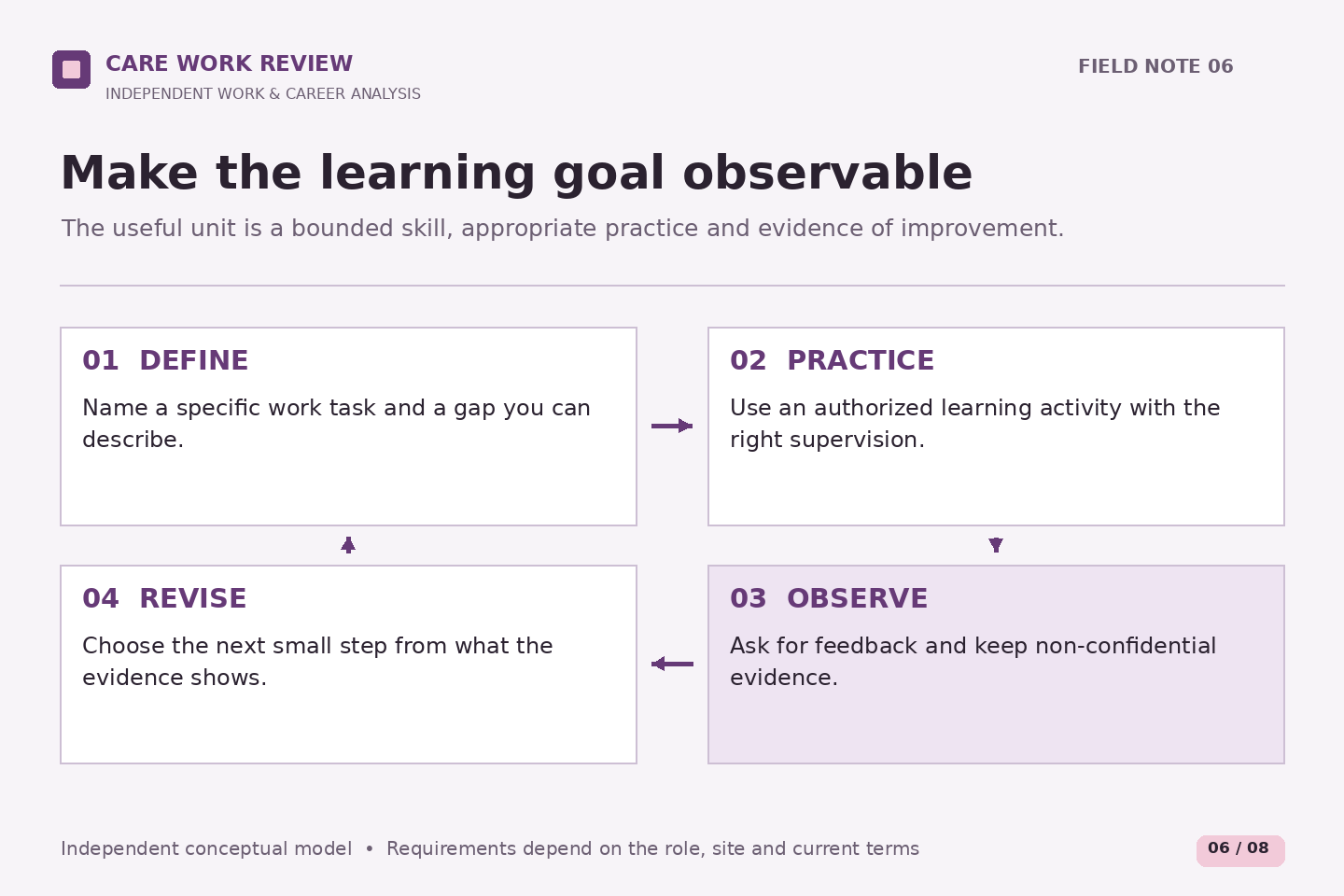
Use a six-field learning card
Our planning card contains goal, starting point, route, support, evidence and review date. The goal names the task. The starting point records what you can currently do or understand. The route describes the proposed learning activity. Support identifies the time, permission, feedback or funding you would need. Evidence says what would demonstrate progress. The review date creates a moment to assess the result.
For a hypothetical administrative learner, the goal might be to summarize a small set of operational data clearly. The route could combine basic spreadsheet instruction with an invented practice dataset. Evidence might be a short summary another person can interpret without additional explanation. No patient or employer data is needed for that exercise.
This card prevents a common mismatch: buying a course because its title sounds useful before knowing whether its content addresses the actual skill gap.
Check the route before buying or enrolling
Read prerequisites, content, delivery format, assessment, total cost and cancellation terms. If the purpose is a formal credential, check the credentialing organization's current requirements and any relevant jurisdictional requirements directly. A provider saying its course is helpful preparation is different from an authority saying it satisfies an entry condition.
For work-related learning, clarify what must be approved before enrollment, whether any funding applies, and which documents are required. Do not assume reimbursement simply because a public careers page mentions educational assistance. Keep a funding decision separate from permission to take time away from work.
MedStar's associate benefits page identifies educational assistance as a broad category. Its nursing pages also describe professional-development structures and academic relationships. These sources justify asking about relevant opportunities; they do not establish that a particular learner will receive funding, a place, a schedule adjustment or a promotion.
Make room for practice and feedback
Attendance and learning are related but different. Build a practical activity into the plan so you can see whether the new knowledge changes what you can explain or produce. Keep the exercise within your authorization and competence. Learning about a clinical task does not authorize performing it independently.
Ask for feedback on something specific. “Is the summary's conclusion supported by the information shown?” gives a reviewer a clearer job than “How am I doing?” If the exercise is hypothetical, label it that way. If it concerns actual work, use approved systems and only information you are authorized to use or share.
Choose a scale that fits the available time. A modest practice task completed and reviewed can reveal more than a large unfinished project. If the route requires supervised practice, include that dependency explicitly instead of treating self-study as an equivalent substitute.
Review the plan with evidence, not only enthusiasm
At the review date, compare the result with the starting point. Can you now explain the concept, complete the practice task or identify the next requirement more accurately? What remains difficult? Keep completion evidence, but also note what the activity did not teach. A certificate of attendance is not proof of proficiency in every related task.
Decide whether to continue, change the route or stop. Stopping can be sensible if the course does not address the goal, the prerequisite is different than expected or the time commitment is not workable. The purpose of a review is to improve the plan, not to defend the first choice because you already spent time on it.
If a learning goal concerns movement to another role, compare current vacancies again. Requirements and openings can change while you study. Development and appointment to a new position remain separate decisions.
Keep the next step small enough to act on
End with one concrete action: verify a prerequisite, ask about the current assistance process, request feedback on an approved practice task, or compare two course outlines against the same goal. Record who or what can answer the question and what evidence would resolve it.
A learning plan should leave you with a clearer capability and a better-informed choice. It is not an implied contract with an employer, and no public program description guarantees advancement. Starting with a task, an evidence test and a review point makes progress visible while keeping commitments proportionate to what you actually know.
Related reading: Ask a career question that someone can actually answer, Make the first month a learning plan, Build an early-career plan that survives a changing vacancy list.