In this guide
Turn early questions into a practical plan for expectations, supervised practice, feedback, and dependable follow-through.
Start with clarity, not a performance sprint
The first month in a healthcare organization contains several kinds of learning at once. You are discovering the work, the people, the local expectations, and the boundaries of your role. Trying to look fully independent too quickly can hide useful questions. A better goal is to become steadily more reliable while making uncertainty visible to the people responsible for your training.
MedStar’s public careers material describes clinical and non-clinical settings, including centralized functions such as technology, accounting, and associate learning. That variety is why a single first-month checklist cannot stand in for a department’s orientation. The four-week framework here is an independent planning aid. Follow the required training, supervision, and safety procedures for your actual role; this article does not authorize any task or clinical activity.
Week one: agree on the shape of the work
Ask your manager or designated orientation lead three concrete questions: What should I understand by the end of this month? Which activities may I observe, practice with supervision, or perform independently? What should I do when instructions appear inconsistent? The answers create a starting boundary. They can also reveal that an early expectation is about accuracy or coordination rather than speed.
Make a small expectations sheet with a responsibility, an observable outcome, the appropriate reviewer, and a review point. For an illustrative administrative role, the outcome might be preparing a sample work summary in the approved format and having a supervisor check it. For a technical role, it might be explaining the permitted change process before touching a production service. Neither example describes a MedStar requirement.
Do not turn the sheet into a second unofficial procedure manual. Record where an expectation came from and ask how revisions are communicated. Keep patient information, security details, and confidential organizational material out of personal notes.
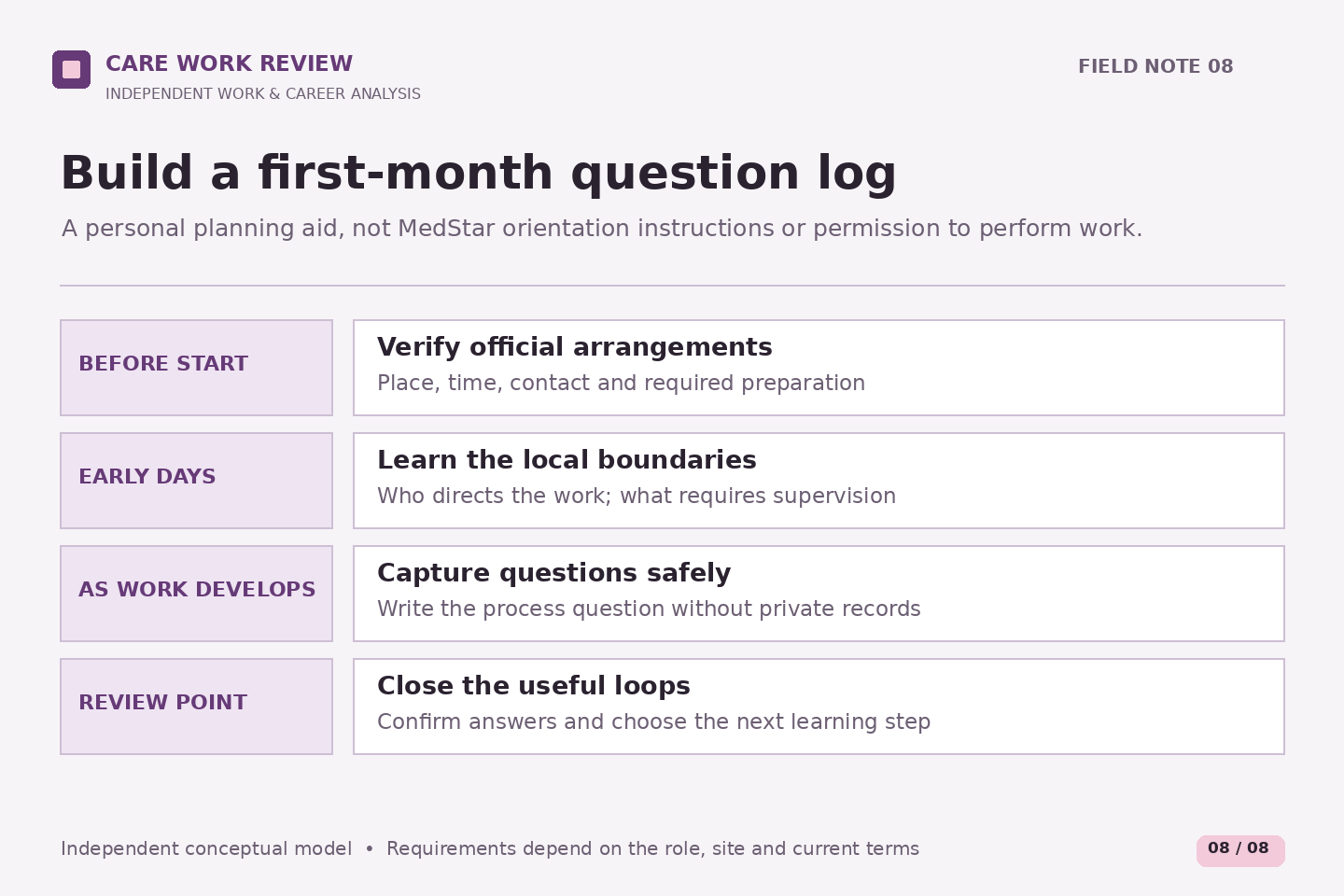
Week two: learn the handoffs
Work often becomes difficult at the point where it passes from one person or team to another. Choose one routine, permitted workflow and identify its starting condition, expected output, recipient, and unresolved-question route. Ask what a complete handoff looks like and what commonly causes avoidable rework. Observe the local method before proposing a replacement.
An illustrative example: an operations associate prepares a daily status summary. Instead of asking only which template to use, they ask which decision the recipient makes from it, when information becomes stale, and what to do when a required field is unavailable. The learning goal is understanding the downstream need. It is not permission to collect extra data or distribute information beyond the authorized audience.
At the end of the week, explain the workflow back to your trainer in plain language. A short teach-back can expose a misunderstood dependency that silent note-taking misses. Invite corrections, then update your understanding.
Week three: practice with a feedback loop
Select one skill that matters to your assigned duties and is appropriate for supervised practice. Define a small attempt, the review standard, and who will review it. Arrange the feedback point before beginning. That makes review part of the work rather than an interruption after someone discovers a problem.
Use a three-line learning note: what I tried, what feedback changed, and what I will check next time. Avoid labels such as “bad at this” or “mastered.” Specific observations are more useful: “I omitted the date range, so the reviewer could not tell which period the summary covered.” Keep examples generic or within the approved workplace record system; learning notes should not become a personal store of sensitive cases.
If several corrections point to the same uncertainty, ask for another demonstration or a smaller practice task. Finishing the calendar’s third week does not prove competence. The pace should follow the role’s requirements and the judgment of the people responsible for supervision.
Week four: compare expectations with evidence
Revisit the initial expectations sheet. For each item, distinguish completed learning, ongoing practice, and a dependency outside your control. A training event attended is different from a skill demonstrated. A task performed once with help is different from independent responsibility. Describe progress precisely enough that your manager can correct it.
Prepare a short review conversation: one responsibility you understand better, one handoff you can now explain, one recurring question, and one next learning goal. Bring examples that can be discussed without unnecessary confidential detail. Ask which priority deserves more attention next month and whether any initial expectation has changed.
Keep the useful habits after day thirty
The first month is a convenient review point, not an official threshold for readiness. Some roles require longer structured orientation, credentials, or competency assessment. Others may need repeated exposure to monthly or seasonal tasks before their full pattern becomes clear. Confirm the relevant milestones with your manager rather than inferring them from this timeline.
Carry forward the habits that make work dependable: clarify the expected output, stay within approved responsibility, check the handoff, and request feedback on a concrete example. The strongest first-month result is a shared picture of what you can do, what you are still learning, and how the next stage will be supported.
Related reading: Keep a work record you can actually use, Turn career learning into a small, testable plan, Send the question to the right place.