In this guide
- Treat the overview as a question map
- Ask eligibility questions before comparing features
- Read health coverage as several separate questions
- Distinguish time away from permission to schedule it
- Keep financial categories separate and conditional
- Create a benefits decision note you can revisit
- Sources and scope
Move from a public benefits overview to the current documents and role-specific questions that can support an employment decision.
Treat the overview as a question map
A public benefits page tells you which subjects to investigate. It usually cannot establish the exact terms for a particular person, position, employment category or coverage period. MedStar's associate benefits page describes broad offerings and says Total Rewards is available to full-time associates and a large percentage of part-time associates. The qualifier matters: a benefits headline is not an individual eligibility decision.
Begin with the exact role and status under discussion. Then ask for the current materials that apply to that category. Keep the plan or program year visible. An attractive summary from an earlier year, another business unit or a different profession may be useful background but is a poor basis for assuming your own terms.
Ask eligibility questions before comparing features
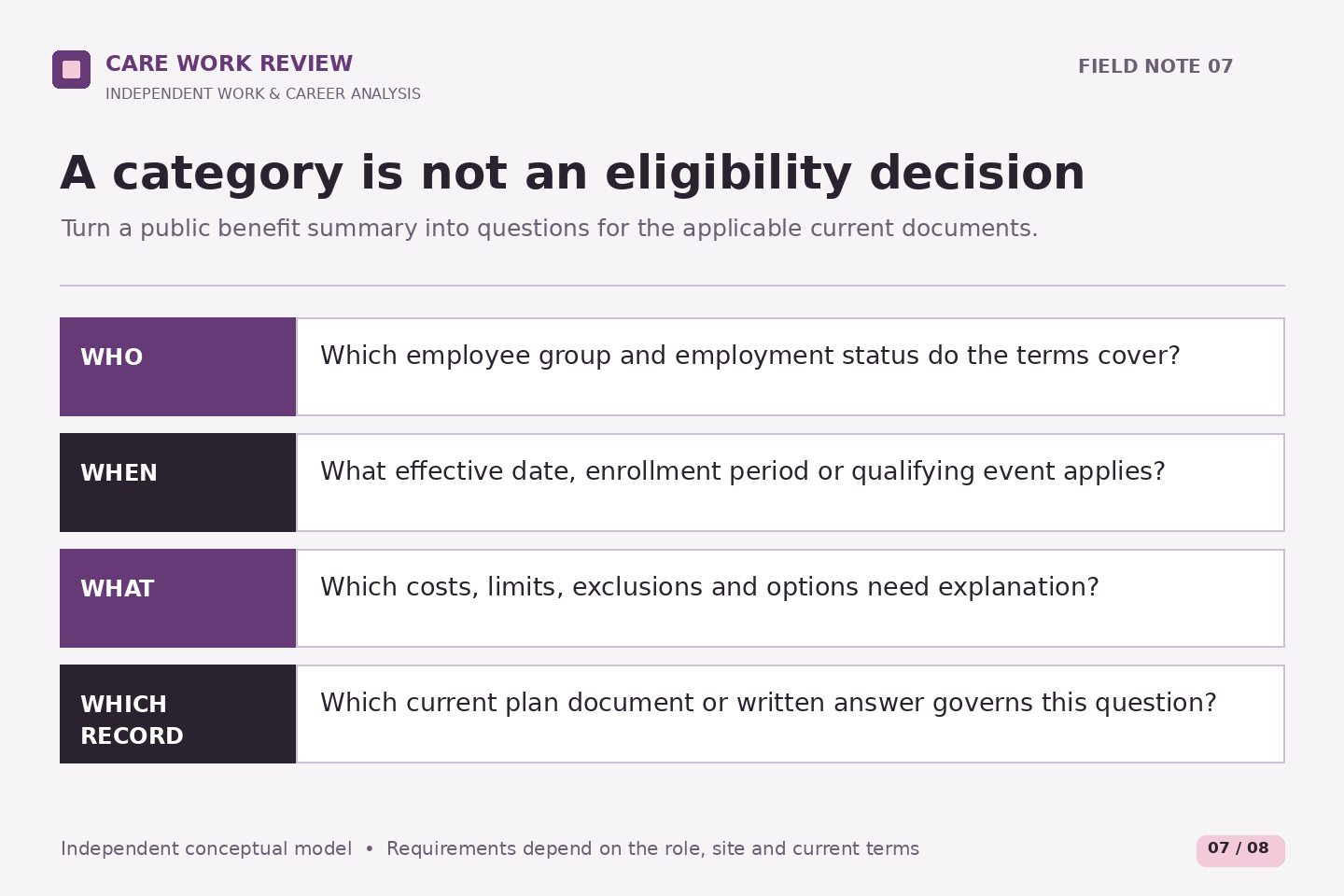
For each benefit that matters to you, establish who is covered, when eligibility begins, what action is required and which document governs. These questions should come before comparing optional features. There is little value in calculating the attractiveness of a provision if you do not yet know whether it applies to the proposed arrangement.
Use a four-column private note: benefit category, applicable document, unresolved question and responsible contact. Keep the note free of unnecessary health or household details. A first question can often be general: “Which current benefits guide applies to this position and employment status?” More personal questions can follow through the appropriate private channel if needed.
The official advanced-practice-provider benefits page illustrates why scope matters. Its disclaimer limits the summary to a defined professional group, refers readers to governing plan documents and notes variation in some terms. That disclaimer should not be generalized into entitlement for other roles.
Read health coverage as several separate questions
When considering health-related coverage, distinguish the employee contribution, the coverage structure, the available network and the relevant enrollment timing. These are different questions, and the public presence of a category such as medical, dental or vision does not answer all of them. Ask for the applicable current documents and use the plan's verified information routes for detailed questions.
If keeping access to a particular provider is important, verify that directly for the exact plan under consideration rather than relying on the provider or insurer name alone. Do not assume that working for a health system means every service is included or available under the same terms. This article does not select a plan, assess medical needs or interpret your individual coverage.
For your own comparison, use the same household assumptions and period on both sides. Otherwise, one option can appear less expensive simply because the comparison quietly uses different coverage choices.
Distinguish time away from permission to schedule it
A paid-time-off category raises several separate questions: how the applicable program works, when time becomes available, how requests are handled and whether other kinds of leave follow different rules. Ask about the documents and process relevant to the role. Do not infer that a balance, accrual description or public summary guarantees approval for particular dates.
If you have an important scheduling constraint, discuss it explicitly at an appropriate stage. Keep the agreement, if any, distinct from your understanding of the general program. A conversation about benefits does not automatically resolve a conversation about staffing or a specific schedule.
Use the same separation for education. Financial assistance, approval of a course, time to attend and recognition of a qualification are different matters. Ask which steps need advance approval and what conditions apply before committing money or assuming that study fits within paid work hours.
Keep financial categories separate and conditional
Retirement programs, insurance products, reimbursement and discounts do not have the same purpose or rules. List the categories that matter, then request the relevant current details. Avoid comparing them by adding every advertised maximum into a single annual compensation total. Some amounts may be conditional, optional, employee-funded or subject to limitations.
For retirement-related questions, ask for the applicable plan materials and the route for understanding participation, contributions and any conditions. For reimbursement, ask which expenses qualify, what approval is needed and when evidence must be supplied. This guide is a document-reading framework, not financial, tax or investment advice.
If a headline amount or vendor name differs between public pages, do not choose the version you prefer. Identify the two pages and the specific discrepancy, then ask the responsible benefits contact which current document applies. Clear source conflicts are useful questions, not a reason to invent certainty.
Create a benefits decision note you can revisit
End the inquiry with a short note containing the proposed employment category, coverage period, documents received, major questions answered and any unresolved point that could change your decision. Separate employer-confirmed information from your estimates and preferences. Record the date so you can recognize when an old comparison needs refreshing.
You do not need to investigate every optional perk with equal intensity. Start with provisions that affect whether the role works for you, then examine smaller extras. A useful benefits conversation resolves material uncertainty rather than producing the longest list of offerings.
If the role or status changes during hiring, confirm whether the same materials still apply. Public pages provide orientation; current applicable documents and authorized explanations supply the detail. Care Work Review has not accessed employee records, evaluated anyone's eligibility or verified an individual enrollment outcome.
Related reading: Compare the offer you can verify, Send the question to the right place, What a public myHR reference can tell you.